
Why Does Driving Make Me Anxious?
There are many things that stress us every day – work, taking care of the house, your family, your dog, paying bills – the list goes on and on. Many Americans find one specific part of their day especially stressful – driving! And while experiencing stress and anxiety is completely normalConditions Generalised Anxiety Disorder Overview #:~:text=Everyone%20has%20feelings%20of%20anxiety Anxious%20can%20be%20perfectly%20normal. Mental Health, these feelings sometimes reach a level that can be difficult to live with, such as when someone experiences driving anxiety.
According to the ZebraDriving Driving Anxiety #:~:text=About%2066%25%20of%20Americans%20experience Made%20people%20the%20most%20anxious. ResourcesDriving Driving Anxiety #:~:text=About%2066%25%20of%20Americans%20experience Made%20people%20the%20most%20anxious. Resources, 66% of Americans experience driving anxiety. So, while it’s helpful to know that you’re not alone in experiencing it, it does not help you answer the important question of why, exactly, driving makes you anxious.
In this article, we hope to help you answer this question by discussing:
What driving anxiety is
What causes driving anxiety
Strategies for handling driving anxiety
What Is Driving Anxiety
According to PsychCentralAnxiety Driving Anxiety#what Is Driving Anxiety Psychcentral.com, driving anxiety is “intense distress while driving and participating in avoidance behaviors, like having other people drive for you or avoiding conditions that make you feel unsafe.” This is a great starting point, but it can be difficult to figure out what distress while driving looks and feels like. We can better understand it by looking at related conditions: general anxiety and phobias.
General Anxiety
The National Institute of Mental HealthTopics Anxiety Disorders HealthTopics Anxiety Disorders HealthTopics Anxiety Disorders HealthTopics Anxiety Disorders Health says that having general anxiety disorder “usually involves a persistent feeling of anxiety or dread, which can interfere with daily life.” Again, feeling anxious is a normal part of being a human, so how does someone know whether they are going through a particularly stressful time or experiencing something more serious?
A general guiding line is that, normally, someone might feel anxious for a day or a week. However, someone suffering from general anxiety disorder may feel anxious for months or years. The best thing to do if you suspect you’re suffering from an anxiety disorder is to seek help from a medical professional.
General Anxiety Disorder might show up as:
Sleeping poorly
Having frequent headaches or stomach aches
Being tired all the time
Frequent irritability
Being unable to concentrate.
Phobia
The National Institute of Mental HealthTopics Anxiety Disorders HealthTopics Anxiety Disorders HealthTopics Anxiety Disorders HealthTopics Anxiety Disorders Health defines a phobia as “an intense fear of—or aversion to—specific objects or situations.” You’ve probably heard of some phobias, like arachnophobia (the fear of spiders) or claustrophobia (the fear of enclosed spaces) – but what does having a phobia look like?
Someone with a phobia might:
Go out of their way to avoid the thing that they fear
Feel highly anxious if they encounter the feared object
Dread encountering the feared object
How Do I Know If I Have Driving Anxiety?
Now that we’ve dug into some of the signs of general anxiety and phobias, we know that someone experiencing driving anxiety might:
Sleep poorly before a big day of driving
Feel exhausted after driving
Feel irritated every time they drive
Struggle with concentration while driving
Go to great lengths to avoid driving
Experience excessive sweating, headaches, dizziness, or stomach aches while driving
With all of this said, it still might feel fuzzy. After all, different people experience anxiety differently2020 01 What Does Anxiety Feel Like Familypsychnj.com and on different levels. Your body’s reaction to anxiety could be different than another person’s experience. Yet another point to consider is how intense your feelings are. So, if you’re still not sure whether what you’re experiencing is normal or not, that’s completely understandable. Consider speaking with a medical professional who is licensed to diagnose anxiety disorders.
What Causes Driving Anxiety?
At this point, you might be wondering how you can resolve your feelings of anxiety. One thing that will inform the best solution for you is what specific action or situation triggers your driving anxiety. So before we discuss possible strategies for managing driving anxiety, let’s talk about what can cause it.
There is no single thing that creates driving anxiety for everyone. In fact, there’s a wide-ranging variety of things that might make someone nervous about driving.
Here are some reasons someone might feel anxious about driving:
Lack of confidence in other drivers. According to an Aceable study,What You Need Know About Driving Anxiety Post Pandemic Blog a third of surveyed drivers who have returned to driving the same amount or more than they did before the pandemic now feel they cannot trust the other drivers on the road.
Lack of confidence in their own skills. According to the same Aceable study, 47% of survey respondents who said they have returned to driving said they were afraid their driving skills deteriorated during the pandemic.
Experiencing hearing/vision loss. Many Americans ( 92% of respondents) said that the pandemic caused them to drive less. During that nearly two-year span, we all got a little older, so many of us have now returned to driving and realized we’ve experienced hearing loss and changes to our vision.
Having a traumatic driving experience: A survey by the zebraDriving Driving Anxiety #:~:text=About%2066%25%20of%20Americans%20experience Made%20people%20the%20most%20anxious. ResourcesDriving Driving Anxiety #:~:text=About%2066%25%20of%20Americans%20experience Made%20people%20the%20most%20anxious. Resources found that about 62% of Americans have had a traumatic experience while driving. This could include witnessing a bad accident, or being part of a car accident.
How Do I Manage Driving Anxiety?
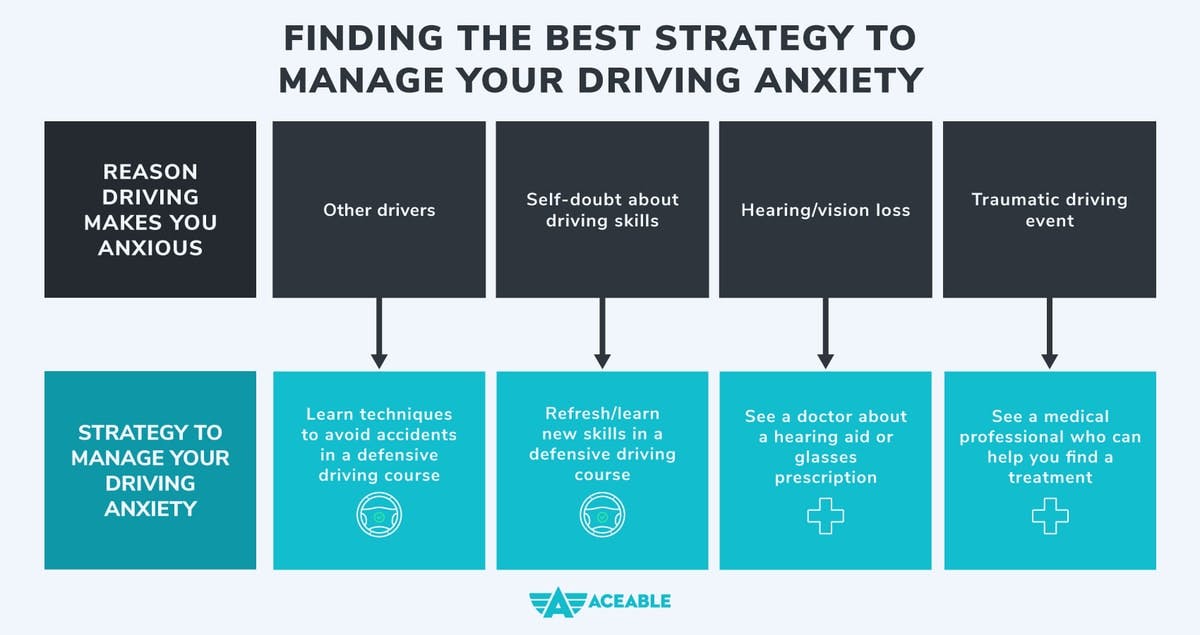
We’ve discussed a lot here, but it all comes down to helping you determine an effective way to manage your driving anxiety. While we will discuss some possible strategies in a moment, it’s important to acknowledge that the right choice depends on your specific situation. Finding the right strategy to manage your driving anxiety depends on what is making you feel anxious, as well as the level of anxiety you’re experiencing.
Gaining Driving Skills
Say, for example, that you lack confidence in your driving ability or the skills of the other drivers around you. In this case, you may be able to ease your anxiety by taking a defensive driving course. Defensive driving not only refreshes your skills but instructs you on how to drive defensivelyDefensive Driving Basics Safe Driving to protect yourself from the mistakes that other drivers make. It also offers tips on how to drive in tricky weather conditions, like snow, ice, and fog.
Mindfulness and Calming Techniques
If you experience a lower level of anxiety around driving, you may be able to calm yourself to help you feel better. Try applying mindfulness techniquesApplying Mindfulness To Driving Articles while driving, taking deep breaths before you head out, or just playing some relaxing music.
Speaking with a Medical Professional
There are also instances where the best choice is to speak to your doctor or another medical professional. Say, for example, that you have experienced hearing loss or your vision has changed. A trip to the doctor for a hearing aid or a new glasses prescription could help you feel more confident when you drive.
On the other hand, if you’re experiencing a high level of anxiety after being in a car accident, or you’ve avoided driving for a long time because it makes you anxious, you may choose to work with a therapist to find a solution.
The good news is anxiety can be treated! When you work with a professional therapist, they may suggest a variety of effective treatments, including:
Cognitive behavioral therapy: According to the National Institute of Mental HealthTopics Anxiety Disorders HealthTopics Anxiety Disorders HealthTopics Anxiety Disorders HealthTopics Anxiety Disorders Health, this therapy “teaches different ways of thinking, behaving, and reacting to situations to help you feel less anxious and fearful.”
Exposure therapy: The American Psychological AssociationPatients And Families Exposure Therapy Ptsd Guideline describes exposure therapy as a series of treatments where a professional creates a safe environment in which their patient can experience the situation or object they fear.
Medication: In some cases, your doctor or therapist may prescribe medications. According to the National Institute of Mental HealthTopics Anxiety Disorders HealthTopics Anxiety Disorders HealthTopics Anxiety Disorders HealthTopics Anxiety Disorders Health, these might include anti-depressants, beta-blockers, or other anti-anxiety medications.
I hope what you take away from this is that you are not alone in feeling anxious about driving, and, while there isn’t a one-size-fits-all solution there are steps you can take to help ease your anxiety.
Here at Aceable, we like to help! While defensive driving is not the right solution for every situation, if you think it could help, please consider signing up for a courseDefensive Driving with us.
Skip The Classroom and Take Your Drivers Ed Course Online with Aceable!
Looking for more driving resources?
Enter your email for deals, study materials, car maintenance tips, insurance savings, and more.